👋 Hi, I’m Xiaoyao.
I’m a low-voltage electrician who spends my days crimping Ethernet connectors, tracing wires, and troubleshooting networks in building server rooms. In my free time, I just love tinkering with things.
Honestly, the internet is flooded with workout advice. If you want to learn how to exercise, a quick search gives you thousands of action videos and training guides.
But with methods everywhere, why do most people (including the past me) still end up working out sporadically, seeing zero results, and eventually quitting?
Because in the everyday life of an average person, fitness gets pushed down the priority list way too easily.
⏱️ Time is Fair, but Energy is Drained by Unpredictability
Everyone has limited energy, and time treats everyone equally—24 hours a day. Why can some people lock workouts into their schedule like clockwork, while others always feel like they “don’t have time”?
The real pain point isn’t laziness. It’s that traditional workouts waste too much time and are full of unpredictability.
When I used to do bodyweight training without strict rest timers, I’d plan to rest for one minute, pick up my phone, start scrolling, and before I knew it, several minutes had passed. A workout that should have taken 30 minutes ended up dragging on for over an hour, wasting time and killing the training quality.
This subtle, unnoticed drain of time creates a sense of drag that eats away at your mental energy. Over time, fitness drops lower and lower on your priority list until it’s abandoned entirely.
This blog post and its companion app, Xiaoyao Workout, were built specifically to tackle this pain point.
Since we are talking about “certainty,” let’s skip the abstract theories and look at the real results. Here is the physical transformation I achieved in just two months using my own training logic and the app I coded:
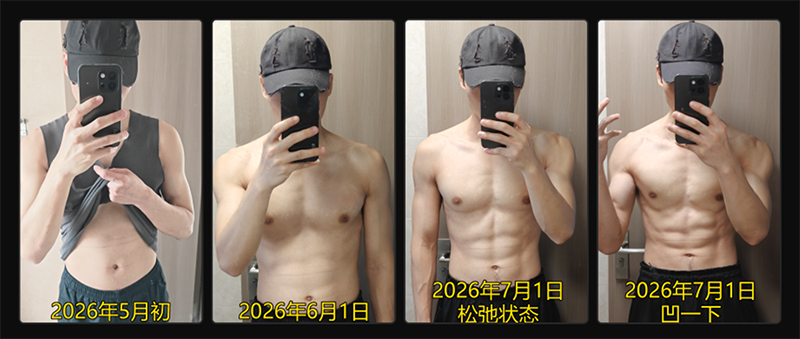
This isn’t superior genetics, nor is it the result of starving myself down. It is simply the natural outcome of setting doable plans, staying consistent, progressively increasing resistance, watching diet, and keeping track with real feedback.
Most people know the principles, but why do so few manage to execute them? Because we need the “certainty” provided by software to counter human procrastination when we are exhausted.
🎯 Trick Your Brain with “Minimum Action”
Often, we struggle to start because we picture the goal as too grand, too painful, and too daunting.
When I first decided to build this app, I naively thought that with AI assistance, I could just throw in a few prompts and finish it in two weeks. If I had known back then that it would take me a full year of late nights wrestling with code and bug fixes, I probably would never have started.
Yet, that “foolish start” unexpectedly forced me to leverage the power of “Minimum Action”—as long as you make that first move, momentum will push you through the rest.
Training works the exact same way. In Xiaoyao Workout, I don’t encourage you to start with an overly ambitious plan.
You can set an intense 30-minute session, or a tiny 10-minute micro-workout. Once you configure your exercises and rest intervals in the app, it calculates an exact total duration.
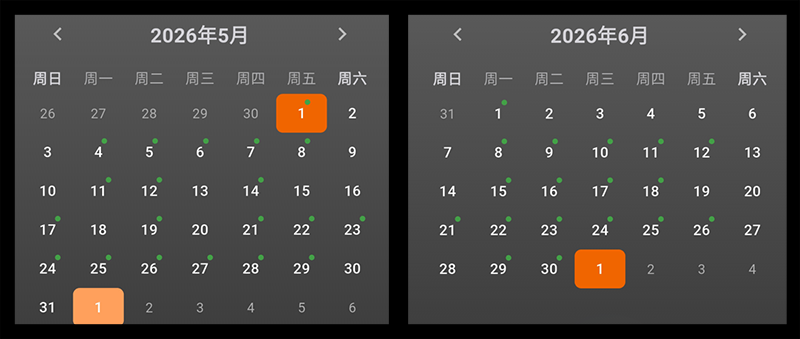
(I strictly control my workout time—each session rarely exceeds 40 minutes)
The moment you tap “Start,” the voice assistant acts like an unemotional coach: “Starting Set 1,” “Rest for 60 seconds.” You don’t need to spend energy filling out spreadsheets after each set. Just follow the rhythm. The second the timer ends, your workout is done, and your log is automatically saved.
Of course, we also respect physical fatigue: if you planned 6 sets but today just isn’t your day, and you hit failure at set 5, the app allows you to adjust the final results.
We pursue certainty, but we never cling to rigid dogmatism.
🛠️ More Than a Tool, It’s an Authentic Log
To professional developers, Xiaoyao Workout might look like just a simple tool with basic features; to fitness pros, a one-arm push-up might be just a fundamental move.
To me, however, they represent a different way of living.
Over the past year, I spent a massive amount of time learning programming and building this app, causing my workouts to fall behind and my physical conditioning to slump. When I restarted, I realized that for ordinary people, the hard part isn’t finding out “what to do,” but figuring out “how to anchor workout routines firmly into the messiness of daily life.”
Xiaoyao Workout aims to solve those annoying little hurdles:
- Not knowing what to train today;
- Not knowing how much you’ve actually accomplished;
- Getting distracted by your phone during rest periods;
- Losing sight of your progress over time.
By providing structured plans, automated timers, voice cues, and offline tracking, it turns something that used to rely on sheer “willpower” into a smooth, natural habit.
🚀 Final Thoughts
This article and the app are not meant to be a silver bullet, but rather a stepping stone to spark your own journey.
I am sharing what worked for me, hoping it helps those who want to change but keep getting stuck on time, energy, and execution.
- Blog Posts: Share the principles, logic, and exercise breakdowns behind the training;
- Companion App: Helps you execute the plan to the letter (100% offline, no ads, no paywalls).
🔗 App Release Page: https://xiaoyao.fit
If you want to see real change in yourself, don’t worry about whether you’ll succeed right away, and don’t wait for “next Monday” or “next month.” Create a simple plan today—even if it’s just for 10 minutes.
Transformation rarely comes from a single moment of grand resolution; it grows out of small, completed actions, time after time.
In the next article, I will use How to Unlock the One-Arm Push-Up as an example to dive into how to break down goals and build your own progression plan using this system.