Before we dive into specific exercises, we need to agree on one fundamental consensus: One-size-fits-all, rigid workout templates are completely counter-human.
If someone can easily knock out 60 standard push-ups in a single set, prescribing them “4 sets × 15 standard push-ups” isn’t real training—it’s slacking off, a total waste of time. Conversely, if someone can’t even complete a single standard push-up, forcing them straight into one-arm push-ups will only lead to joint injuries and overwhelming frustration.
We don’t deal in rigid pass/fail standards here. In this article, I will share how to use precise self-testing combined with the Xiaoyao Workout app to design a highly effective training plan tailored entirely to your current physical limits. This isn’t set in stone; this post is meant to provide a practical framework and a guiding mindset.
🔍 Step 1: Benchmark Testing (Find Your Starting Point)
Pick a day when you feel fully energized, warm up thoroughly, and perform a max-rep test for standard push-ups with strict form (keep your body in a straight line, lower your chest until it almost touches the ground, push back up without momentum or sagging hips).
Remember: quality always takes priority over quantity.
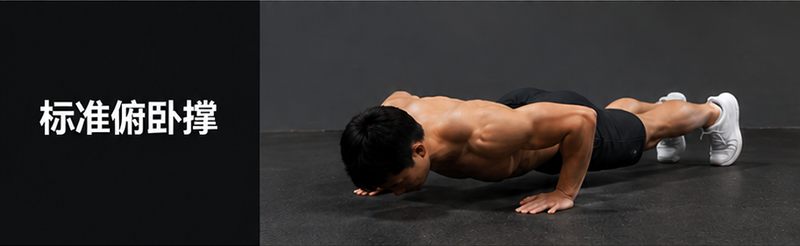
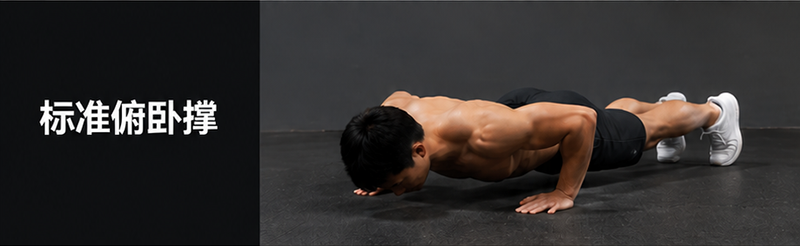
📸 Standard Push-Up Demonstration: Keep your body in a straight line, lowering your chest until it almost touches the floor.
Once tested, locate your starting progression step in the table below based on your max reps. Note that these are references rather than set rules—I encourage you to choose your starting point based on your actual physical condition:
| Standard Push-Up Max Reps | Your Initial Step | Primary Exercise in App | Recommended Rest |
|---|---|---|---|
| < 5 reps | Step 1: Regression Foundation | Incline Push-Up / Knee Push-Up | 60 seconds |
| 5 – 25 reps | Step 2: Standard Strength | Standard Push-Up | 60 seconds |
| 26 – 40 reps | Step 3: Narrow Focus | Narrow (Diamond) Push-Up | 60 seconds |
| 41 – 55 reps | Step 4: Asymmetric Leap | Archer Push-Up (Even count) | 90 seconds |
| > 55 reps | Step 5: Ultimate Unlock | One-Arm Push-Up (Even count / switch hands) | 120 seconds |
📈 Step 2: The “Front-Heavy, Rear-Light” Progression Strategy
Once you’ve identified your stage, how should you structure your routine?
Even if you’ve reached Step 5, I wouldn’t recommend jumping straight into 6 full sets of one-arm push-ups—your stamina rapidly depletes set after set. Our guiding principle is: Keep total sets fixed, while dynamically scaling difficulty.
Regardless of your stage, keep a consistent workout structure. For instance, complete 6 sets per session, aiming for 8 to 15 reps per set (choose a rep target that pushes your limit while maintaining strict form). A fixed structure builds consistency, while difficulty dynamically adapts to your body’s feedback:
- 🔹 Early Progression Phase: Perform the advanced exercise for the first 2 sets, then regress to the previous stage’s base exercise for the remaining 4 sets.
- 🔸 Intermediate Phase: Once adapted, adjust your plan to 4 sets of the advanced exercise followed by 2 sets of the base exercise.
- 🔹 Full Mastery: Once you can complete all 6 sets using the advanced exercise at your target rep range, you are ready to officially move up to the next step.
💡 Principles for Regression and Progression Adjustments
What should you do if you hit muscle failure before completing your target reps during a set? Regress immediately!
Switch to an easier variation and finish the remaining reps of that set. Never sacrifice form just to hit a number—improper compensation stalls progress and increases injury risk.
If you find yourself regressing during more than two sets in a single session, it means the current workout intensity exceeds your capacity. Lower the difficulty or reduce target reps in the app. Honesty without fluff is the fastest shortcut to real progress.
Conversely, progression shouldn’t happen all at once. Use a set-by-set transition approach (e.g., start by replacing just 1 set with the advanced exercise, then increase to 2 sets as you adapt). Pace yourself based on body feedback. Effective training is about smart, real-time adjustments—not mechanical execution.
⚖️ Step 3: The “Even-Number Rule” for Advanced Exercises
When you reach Steps 4 and 5 (Archer and One-Arm Push-Ups), the asymmetrical loading places different stress on each side of your body. To ensure balanced muscular development, apply the Even-Number Rule:
For bilateral alternating movements, keep total reps per set to an even number (e.g., 8, 10, 12, or 14 reps).
- Archer Push-Up (Alternating Reps): Perform 1 rep on the left side, then 1 rep on the right. If your target is 12 reps per set, that translates to 6 reps on each side—perfect symmetry.
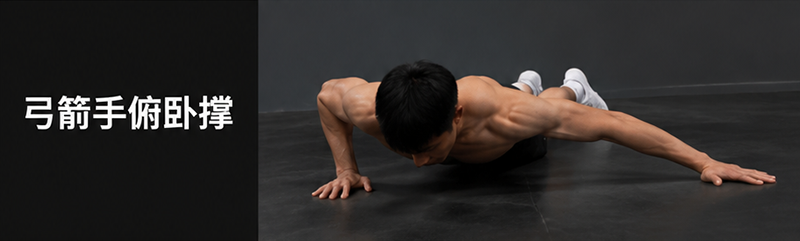
📸 Archer Push-Up Demonstration: Shift your center of gravity laterally while keeping the supporting arm straight for assistance.
- One-Arm Push-Up (Half-Set Switch): Because one-arm push-ups are extremely demanding, switching arms after every rep breaks your rhythm and mechanics. If your target is 10 reps, complete 5 consecutive reps on one arm first, then switch and perform 5 reps on the other arm.
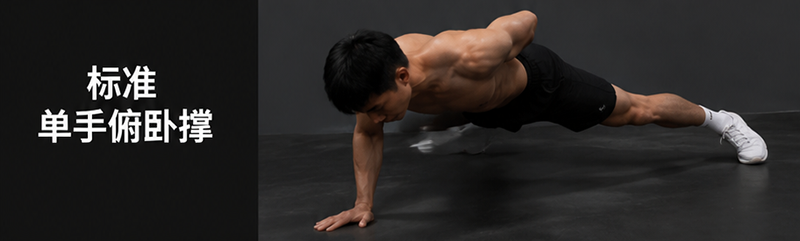
📸 One-Arm Push-Up Demonstration: Place your working hand directly under your chest and widen your feet stance for optimal stability.
⚙️ Step 4: Build Your Custom Routine in Xiaoyao Workout
Now, open your Xiaoyao Workout app.
Input your selected exercises, set counts, and rest intervals (Standard: 60s / Archer: 90s / One-Arm: 120s) into your custom exercise library, then combine them into your tailored workout plan.
The app will automatically calculate your total workout duration. As long as you stay focused without pausing unnecessarily, the estimated duration will match your actual time spent training down to the minute.
Wrap it up in 10 to 20 focused minutes. Wipe off the sweat, and dedicate the remaining 23+ hours of your day to life and what you love.
In the next article, we’ll dive deep into each of these five stages, breaking down technical movement details and power mechanics! Stay tuned.